Navigation
- Home
- Philosophy
- Europe
- International
- Peace efforts
- Artists beyond Images
- Culture
- Conferences
- Newsletter
- Links
- Imprint
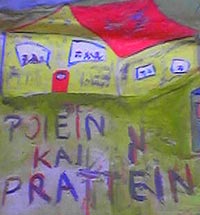
A Poem of the Other - contribution to World Poetry Movement Day on 24th of September 2011
Recently the World Poetry Movement has been joined by the "100,000 Poets for Change" project (www.100TPC.org), a bold initiative by poets Michael Rothenberg and Terri Carrión, in California, who have proposed the implementation of a worldwide poetic action, next September 24th, 2011 in 350 cities worldwide.
http://www.bigbridge.org/100thousandpoetsforchange/?page_id=4670
Due to the nature of poetry, the World Poetry Movement supports and will always support the thoughts, actions and measures that can contribute to world peace, the defense of all life on earth, the sustainable development of a new world, the restoration of beauty, dignity and truth, in the process of a persistent strengthening of poetry's presence in contemporary society worldwide.
Poetry is knowledge, reflection and enlightenment, liberation, contemplation and action, lightning, creative imagination and brotherhood, spiritual unity of individuals and peoples, past, present and future of humanity.
World Poetry Movement calls on all its members, poets and international poetry festivals, to plan, develop and spread poetic actions and Simultaneous poetry readings, across the planet, next September 24th, 2011, to consolidate our organizational process, making a formidable display of poetic power possible in the world, in hundreds of cities and villages on Earth.
We ask you to please inform us shortly on the decisions taken regarding this proposal to the following email: worldpoetrymovement@gmail.com
WORLD POETRY MOVEMENT COORDINATING COMMITTEE
Peter Rorvik (South Africa), Bas Kwakman (Netherlands), Jack Hirschman (United States of America), RatiSaxena (India), Alex Pausides (Cuba), Amir Or (Israel), IrynaVikyrchak (Ukraine), Fernando Rendón (Colombia).
Contact:
Fernando Rendón
Member of Coordination Committee WPM
|
The Question of Poetry in an uncertain world Statement by WPM as to why world wide poetry actions were taking place on September 24, 2012 |
|
| This statement by WPM was read throughout the world on the 24th of September |
|
|
We gather today to increase an exultant wave of poetry, which is moving through the world, from stage to stage where people linked attend the same desire, the same aspiration to take the challenge of the great transformations of the spirit, building a gesture, an openness to all the changes and disruptions necessary to establish a world according to life and not subject to the designs of the devastation. Today we celebrate that we are a joyful transition into a new time, into a new atmosphere where that make possible a congregant light and peace without treaties and without demagogy. Today we are not here to blame the man because of his excesses towards the catastrophe but to increase the radiant energy of poetry, that moves forward as a light network towards new dimensions of consciousness, to take in the majesty of the horizon of our time. Today brings us together a fresh impetus, with the aim of influencing the urgent transformations, facing the challenges of this moment that threatens the life of many species, including humans. Today this call is made possible by the concurrent power of poetry and the poem is the magical instrument for expanding the dislocating power needed to open our minds, our hearts and our mind and so jump to that dimension where we can carry our dreams, symbols and desires to the level of achievements. We know that a poem will not stop tsunamis, nor wars. A poem will not heal 1.020 million people chronically hungry in the world; a poem will not stop the starvation of 750.000 people in Somalia. But a poem is expressed for reaffirmation of life, singing activated by radiant energy of poetry that is a celebration of light. A poem will not solve the basic problems of a defied humanity. But a poem is sung dream, vision, oxygen for the spirit A poem will not conjure the monsters climate. But a poem is a door that opens when everything seems a dead-end. A poem prepares the mind for what will be and what is not yet known.A poem is not mercenary of any disgrace. A poem is the place of magic and symbolic conjunctions that reaffirm us as a species, exscinded between the animal and human. A poem is dreaming the world anew, and in this it gives validity and meaning to the reality we live in. A poem goes on creating the mental future from which our civilization of tomorrow will grow. Therefore a society that fails in the field of art and literature is a society that has become mentally fossilized and harmed its own capacity for self renewal and rejuvenation. Poems remind us that starvation, war, overpopulation and pollution are not the effects of our lack of technology or resources, but the lack of ethics and love. And poems are keys that can open for us the treasure house of our common riches - human love, wisdom, creativity and beauty: riches that are made abundant when shared. We invoke the powers of poetry not to fall into the macabre game of barbarism. A poem is a driver desiring change, looking for a new oxygen under a sky of lead and sulfur. A poem is the cause of the great spiritual convergences. A poem shows us that poetry is the ecology of the symbolic ecosystems. Poetry is the biology of the mind, the engine of the dreamers, of those who aspire to make the leap to a new dimension of being where it is possible to exist without the burden of the iniquities that we inherited and that it is time to stop. Poems to feed the dream for a true humanity finally liberated from the big mistakes. For the dignity that gives us the poetry, today we joined a global chorus of life, for real change, now that we move through a dangerous edgeof our human history. |
|
|
|
|
Please visit:
|
|
athens, Greece
The Poem of the other
Poetry Reading on September 24, 2012
organized by Poiein kai Prattein

Poets would say: sojourn! A day is like a breath of life
which strokes the leaves of trees standing beside the sea.
They remember shore lines drawn softly like eyebrows
in an elongated face turned towards the moon and the sea.
It makes shadows appear to skate over water with a promise
to return with the dreams they have discovered in Atlantis.
Hatto Fischer Athens 8.9.2011
Poems read by:
Pavlina Beremi
Socrates Kabouropoulos
Thomas Economacos
Hatto Fischer
Poets with their own contribution
Ulrike Kölsch, Berlin
Ignacio Livianos Magraner, Valencia
Anjan Sen, Bengali
Armin Groepler, Berlin
Hatto Fischer, Athens / Berlin
Maria Kaliabetsou, Athens
Heinz Subat, Görlitz
Socrates Kabouropoulos, Athens
'A poem of the other' were suggested by following persons:
Alexandra Szymanska, Gdansk the poem 'Fourfold' by Tadeusz Dabrowski
Natalia Grincheva, London: Russian poem by Александр Блок: "Есть игра: осторожно войти..."
Thomas Economacos, Athens: „Change“
George Crane, USA/ Paros: „The Plum Poems“
Niels Righoldt, a poem about being Danish by poet Benny Anderson
Cathy Spennato, one poem by Coleridge, another by Blake
along with the statement by the World Poetry Movement to mark this special day world wide.
Poets with own contribution
Ulrike Kölsch, Berlin

Nun fühl ich es,
jetzt wird es konkret.
Gewißheit sagt es ist nicht zu spät,
das Erkennen braucht Zeit.
Erfahrung und Leid,
seh ich zurück, seh ich mich kaum,
verwirklichte Wünsche?
Ungelebter Traum?
Bricht der Nebel nun auf, durch das Strahlen der Sonne,
Glückvoller Blick, Lachen
Seh ich mich jetzt, ist es ein Leben,
gewonnen, genommen, Zeichen vernommen.
Geh! Nimm! Gib! Zeit und Raum,
Zerschlag nicht die Blasen und wälz´ dich im Schaum!

 ---------------------

Now I feel it,
From now on it is becoming concrete.
Certainty tells me it is not too late,
but knowledge needs time.
Experience and pain.
When looking back, I hardly see myself,
realized wishes?
Unlived dreams?
Now the fog lifts, due to sun rays,
A glance filled with happiness, laughter.
Now I see myself, it is a life,
won, taken, attentive to signs.
Go! Take! Give! Time and space,
do not smash the bubble and roll yourself in foam!
Ignacio Livianos Magraner, Valencia
"Ignacio, 17 in 2011,  is a full adolescent joning the INDIGNADOS  in Valencia and everywhere he goes and he reads and writes a lot." - Ana Magraner

 homenaje a Walt Whitman
¡Que maravilloso es
andar tán solo con unos pantalones blancos!

La planta en la planta sentir,
y la tierra acompañar.

Aplastar hojas de hierba
y verlas levantarse de nuevo.
Las mismas hojas en África,
bajo los hermosos pies de los australianos,
de los escritores libres
y libres pintores;
las hojas de mi cabeza,
y las de mis compañeros.

Ver los reflejos destellos
del sol en el lino,
el movimiento de mis piernas blancas
que siempre me han sujetado
y me han llevado a mi destino.

Mostrar mi torso desnudo
al calor del Sol
con sus rayos verticales horizontales y oblicuos
incidiendo en mi piel color Sol.
Otras hojas de hierba surgen y se aplastan aquí.

En mi cabeza
tambien hay hojas de hierba,
que viven a la intemperie.
Sensibles al viento y agua
y todo tipo de intempestades.
Nada las cubre o protege,
están abiertas a la risa de los arbóles
mi hojas de hierba aman la vida.
Anjan Sen in Bengali

From the eye
Begins the sky
And greeness
you are standing in darkness
of terror
And hunger
Waiting for light.
(taken from Prisoner's dilemma)
The World Poetry Movement day was celebrated at Little Magazine LIBRARY AND RESEARCH Centre in Kolkata on 24th of September 2011.
Poets reading:
Anuradha Mahapatra, Maumita Pal, Josna Karmakar, Dipen Ray, Kallol Sadhdeb,(Bengali), Bablu Roychoudhury (Bengali and Hindi)
along with 8 poems of poets from other continents (read in their English translations).
Secratary Sandip Dutta read the Statement issued by World Poetry Movement.
Anjan Sen discussed poetry movement.
Armin Gröpler, Berlin

Existenz |
Existence |
|
1 |
1 Today it was again about the consciousness of my family and the night stars were the ones which consoled me. The wind through the trees, the bird, in a row with a cat, and the songs of Franz Schubert, despite being so tragic their beauty sustains my life! |
|
2 |
2 Why should I bother about my body, When my emotions are terrified? The many political deceased ones: positive friends for a better life…
Why be bothered by political arguments when all pleasure has been lost due to a violent state. |
|
3 |
3 He who lives and calculates death by war has lost out on life.
Especially when it is not his own death which he plans for. |
|
4 |
4 The spoiled food, The polluted air – The nuclear reactors’ disasters, also criminal acts by governments shall not decrease my love and trust in the stars, the deer, trees and worms, viruses and bacteria. Wind and moon, the bodies of water oceans and seas, lakes and ponds: is where life does exist. |
|
5 |
5 When is life given away? When a dream left unrealized? The more ideology, the more shall life be buried under! The one who does not see the swallow’s flight, has missed out on life. |
|
6 |
6 He who draws a border between animal and human being as a living creature, has lost the game. That we eat animals is enough a connection to demand respect for the animal creature. |
|
7 |
7 Learn to speak the language of animals! Talk with the bacillus… Learn from the welting flowers – when they have become immortals, then you will understand your own dying. |
|
8 |
8 Once religion mutates into ideology, It undermines fife, becomes intolerant and aggressive. |
Hatto Fischer, Athens / Berlin

Hatto with Chonia Photo: Petra Zahrt
Das andere Ich in einer anderen Sprache The other 'I' in another language
|
Spaces matter, so do dances, but why breathe so heavily? Everything is light, lighter than your dreams while my unwritten wish longs for the street that passes by your house beside the sea with the hills behind watching over the entire horizon like grandparents do over their grandchild! Now and then dexterity spreads its wings and calls for new births, a moment of happiness, and something to give like a piece of bread and a plain glass of water, just to sober down the spirits. 21.9.2011 |
Warum wunderst Du Dich? Ich rief Dich, lange, ehe es hell wurde. Der Morgen schlief noch als ich Dich zu wecken versuchte, aber Du warst allzu weit entfernt. Ich konnte nicht meinen Augen trauen, noch die schwarzen Ringe entfernen, aber es kroch etwas heran. Zuerst dachte ich es war eine Schlange, eine die dort zubeißen will wo Gewalt vorherrscht, aber dann gestand der ankommende Tag seinen tiefsten Wunsch, dem Land möge von solch einem Vertrauen durchzogen sein, daß alle diesen Wert der sinnlichen Wahrnehmung berühren, wie Füsse den sanften Sand oder die kühlen Fliessen wenn noch der Schatten vorherrscht und die Sonne erst später kommt. 21.9.2011 |
Maria Kaliabetsou, Athens
|
αρχαϊκό
Παγώνω σε βολική στάση, |
|
Heinz Subat, Görlitz
Written ten years ago, and revisited 10 days ago, dedicated to the victims of 9-11
HS 21.9.2011
The Victims
We didn't want to live forever,
Just wanted some more years to stay.
We won't forget what happened, never.
Maybe we will forgive someday.
Now that we've gone through heavens door
we think about the friends we miss,
would like to see our home once more
and meet our pets for one last kiss.
Want take our children by the hand
and love them warm and hold them tightly,
give them the power of this land,
where love and peace are shining brightly.
And if we get the chance to help them,
we will protect their way of life.
But they should realize that peace
on earth will come with love, not with a knife.
Please let our death not be in vain.
Further poems by Heinz Subat at http://www.sub-poesie.de
Socrates Kabouropoulos, Athens
INCIDENTS RELATED TO THE 1ST YEAR OF MY SON
*
you turn around, in the upright position
and give me your butter-fly smile
*
tea spoon and tea fork
tea tie and T tock
t-aim-ed
*
asleep gone, and beautiful
coming back
*
ever since you asked me if ‘I’m Ok’
I’m not
*
our skin
ages
when we grow up
*
I dreamt of an obscure, hostile crowd, rarely taking notice of him, praising him -sometimes- with excessive compliments.
He was not influenced -the boy. Chewing his finger, he stared at things, in a state of light foretelling their end.
*
the tiger you watched carefully
the hare caught your attention
the birds scared you, made you cry
a goat comforted you
then we sat peacefully by the window
to watch the few last drops of sunlight
on the savannah
Suggestions of 'a poem of the other' by others
Aleksandra Szymanska, Gdansk
The Fourfold
Tadeusz Dąbrowski
Translated from the Polish by Antonia Lloyd-Jones
Doom has come to you,
you who dwell in the land.
–Ezekiel 7:7
Automobiles are flowing like droplets down the string of the highway,
then all of a sudden they’re absorbed into housing estates and courtyards,
the reinforced concrete gardens of hypermarkets. Water
does not wash anything clean, it insistently drums on the brow, seeking
the plumb-line; droplet asking droplet what’s the way.
I turn onto my other side, here naked trees
flex themselves, as if trying to use their youthful branches
to prop up the sky’s support wall, on which weevils
are skillfully pretending to be seagulls and a damp mark is just as
remarkably spreading to form some artificial rose.
I get up, wake up, switch on the TV; the world goes
back to the beginning.
Source: http://bostonreview.net/BR35.3/dabrowski2.php
For further poetry activities in Gdansk, see
http://www.europejskipoetawolnosci.pl/en/2012/
Natalia Grincheva, London
Ph D student in London with focus on 'cultural diplomacy', has send her favorite poem. It shall be read in Athens by Katerina Anghelaki Rooke who has translated Pushkin and other Russian poets / writers into Greek. Since this poem was written just prior to the start of First World War and the Russian Revolution, it may signal what lies ahead and thus can refer to the others as speaking in the wind about changes ahead. Amplified by Pasternak's Dr. Zhivago, the poet spirit evolved around a spirit called Laura: that staunch and independent beauty which holds steadfastly onto values nearly squandered in a crisis. It will be interesting, therefore, to listen to this poem in Russian and then find a way to understand its words revealing the richness of the Russian language speaking always as Katerina Anghelaki Rooke would say to the 'human soul'.
Александр Блок
"Есть игра: осторожно войти..."
* * *
Есть игра: осторожно войти,
Чтоб вниманье людей усыпить;
И глазами добычу найти;
И за ней незаметно следить.
Как бы ни был нечуток и груб
Человек, за которым следят, —
Он почувствует пристальный взгляд
Хоть в углах еле дрогнувших губ.
А другой — точно сразу поймет:
Вздрогнут плечи, рука у него;
Обернется — и нет ничего;
Между тем — беспокойство растет.
Тем и страшен невидимый взгляд,
Что его невозможно поймать;
Чуешь ты, но не можешь понять,
Чьи глаза за тобою следят.
Не корысть, не влюбленность, не месть;
Так — игра, как игра у детей:
И в собрании каждом людей
Эти тайные сыщики есть.
Ты и сам иногда не поймешь,
Отчего так бывает порой,
Что собою ты к людям придешь,
А уйдешь от людей — не собой.
Есть дурной и хороший есть глаз,
Только лучше б ничей не следил:
Слишком много есть в каждом из нас
Неизвестных, играющих сил...
О, тоска! Через тысячу лет
Мы не сможем измерить души:
Мы услышим полет всех планет,
Громовые раскаты в тиши...
А пока — в неизвестном живем
И не ведаем сил мы своих,
И, как дети, играя с огнем,
Обжигаем себя и других...
18 декабря 1913
Thomas Economacos, Athens
Change
1
I walk down the street
There is a deep hole in the pavement
I fall in
I am lost I am helpless
It isn#t my fault
It takes forever to find my way out.
2
I walk down the same street
There is a deep hole in the pavement
I fall in again
I can't believe I'm in the same place
But it isn't my fault
It still takes a long time to get out.
3
I walk down the same street
There is a deep hole in the pavement
I see it is there
I still fall in. It's a habit
I know where I am
It is my fault
I get out immediately
4
I walk down the same street
There is a hole in the pavement
I walk around it
5
I walk down another street
George Crane, Paros / USA
The writer George Crane dares to use in his novels poetry. This can be seen on hand of his book „Beyond the House of the False Lama“ as it contains the famous plum poems. He translated them out of Chinese into English with the help of a monk who had brought with him the plum poems. If anything, these poems are not just from one other poet, but from two. As George Crane explains himself with regards to „A Thousand Pieces of Snow“:
„As both the thirteenth century and the Yüan dynasty (1260-1368) wereng, the poet Fung Hae Suh, who called himself Guaiguai Daoren, the Weird Monk, wrote is most famous work, One Hundred Verses on Flowering Plumes, a mediation on the illusionary nature of a tree that bears no fruit but flowers in late winter, dropping yellow petals dot-dot-dot on the snow.
More than three centuries later, near the end of the Ming dynasty (1368 – 1643), Zhou Lu Jing, a poet fond of metal and stone, of calligraphy and ancient texts, and who had adopted the name Midian Daoren, Hermit Crazy about Plum, wrote, perhaps in the garden he'd planted with plum and bamboo, 101 verse answers to Fung Hae Suh. Combined, they are „a thousand pieces of snow“.
|
Fung Hae Suh |
Zhou Lu Jing |
|
Ancient Plum |
|
|
By the sky oh how long ago grew ancient Gua-shan
celebrated flower shared before and after Po-sung River
only today I woke early to plant new trees
next generation watch all is the same as before. |
Gorgeous great and magnificent tree no one knows in what year?
Fresh and gray - ancient horizontal branch
the whole an old dragon twisted and curled in its cave
blooming flowers like snow cover Jiang-cheng. |
With the permission of the author
George Crane, Beyond the House of the False Lama, Harper Collins Publisher, NY 2005
Niels Righolt wrote:
"Sounds so fine with the Poetry Day. Are you familiar with the danish poet of Benny Andersen? He wrote once on being Danish in the poem Skabssvenskere..."
Benny Andersen
"Er der noget så dansk som en kartoffel?
Kartoflen stammer fra Sydamerika.
Er der noget så dansk som selve Dannebrog?
Det faldt fra himlen ned engang i Estland
og minder om det schweiziske flag.
Klinger noget mere ægte dansk
end musikken til sygestykket Elverhøj?
Komponeret af en tysker med flittig brug
af svenske folkemelodier.
Pas på
nu bliver det svært:
Findes der noget mere danske end danskerne?
Efterkommere af Danerne
en folkestamme fra Sverige
invaderede vort land en gang i 300-tallet.""
Cathy Spennato, Gatineau, Quebec: either a poem from Coleridge or Blake
„OK, OK, you've convinced me. I'll offer you some poems.
One of my favourite poems is one by Samuel Taylor Coleridge called "Kubla Khan", which may be of interest to a group of poets. It begins,
In Xanadu did Kubla Khan
A stately pleasure dome decree:
Where Alph the sacred river ran
Through caverns measureless to man
Down to a sunless sea . . .
and ends with:
. . . Beware! Beware!
His flashing eyes, his floating hair!
Weave a circle round him thrice,
And close your eyes with holy dread,
For he on honey-dew hath fed,
And drunk the milk of Paradise."
Some critics think that the person being described is the poet, who can weave spells with words, others that it he is a prophet or some other sort of messianic or charismatic person (thus, "flashing eyes"). The images & the sound patterns are almost hypnotic in this poem; they are capable of casting a spell on the listener/reader.
I believe Coleridge said it was inspired by a vision he had experienced. Some ascribe this vision to his addiction to hallucinatory drugs, but that does not change the impact of the experience conveyed in this poem. It is unique in the history of English literature, no one having been able to imitate the style or content of Coleridge's work.
I have not included the rest of the text because it is one of the most famous poems in the language & can be found in any anthology.
Incidentally, Coleridge was also something of a philosopher who wrote about the nature of reality & of the creative imagination. His philosophical writings are heavy going, but I managed to garner some interesting ideas from them when I read them many moons ago.
Another unique poet is William Blake who wrote "Jerusalem", which was set to music & is a favourite Anglican hymn. Blake was another visionary poet whose images are very striking: you're probably familiar with the beginning of the poem about a tiger -
Tyger! Tyger! burning bright
In the forests of the night,
What immortal hand or eye
Could frame thy fearful symmetry?"
The verse is repeated at the end of the poem, but the 2nd last verse is
When the stars threw down their spears,
And watered heaven with their tears,
Did he smile his work to see?
Did he who made the lamb make thee?"
Blake was also an engraver whose pictorial images are also striking & like Coleridge, he suffered from bouts of emotional instability.
Both of these poems are centuries old & are unfashionable in that they rhyme, but they are still popular with readers of poetry. They also illustrate to the budding poet the fact that it is possible to rhyme without being unsophisticated or jiggedy-joggedy (as in nursery rhymes). Although . . . internal rhymes are perhaps more subtle.
Don't get me started . . . I spent 4 yrs. of my life studying this sort of thing & 30 yrs. trying to share it with others (most of whom were not even remotely interested). I could go on forever, but
I won't. I did get started, but it's not too late to stop!
I don't know if my choice of poem is the sort of thing you want or not. It's the one that keeps echoing in my mind when I think of poetry (excerpts, of course).“
« Alfabeta | Delegation of World Poetry Movement in Paris, Brussels and Antwerpen 21-27.3.2012 »