Navigation
- Home
- Philosophy
- Europe
- International
- Peace efforts
- Poets
- Culture
- Conferences
- Newsletter
- Links
- Imprint
Bourouina Gallery
BOUROUINA GALLERY

CARMERSTRASSE 11, D-10623 BERLIN
T +49 30 755 12 477   M +49 170 960 2900
www.bourouina.com
Vanity Exhibition


The Clock
Remember! Souviens-toi! Esto memor!
(My metal throat can speak all languages.)
Minutes, blithesome mortal, are bits of ore
That you must not release without extracting the gold

Remember, Time is a greedy player
Who wins without cheating, every round! It's the law.
The daylight wanes; the night deepens; remember!

The abyss thirsts always; the water-clock runs low.
Soon will sound the hour when divine Chance,
When august Virtue, your still virgin wife,
When even Repentance (the very last of inns!),
When all will say: Die, old coward! it is too late!"

- Charles Baudelaire -

Note: "About Boudelaire, it seems unthinkable to do an exhibition about vanity without referring to him!" - Amel Bourouina

|
|
VANITY CASE
Opening: Friday, December 5, 2014: 6 - 9 p.m
With works by:
BORIS BEAUCARNE, LAURA BRUCE, HUBERT CZEREPOK, MARKUS DRAPER, GEORG HEROLD, MATTHIAS HESSELBACHER, ANDY HOPE 1930, BENJAMIN KATZ, DAVID KROELL, ZOFIA KULIK, JOEP VAN LIEFLAND, ROBERT LUCANDER, JONATHAN MEESE, PAUL NUDD, FRED RUBIN, HEIDI SPECKER, MICHEL WÜRTHLE...
The exhibition Vanity
|
|
The Exhibition Vanity takes a fresh look at a recurring motif in art history since the Seventh Century: the Vanities. In a various and dense installation we will show reinterpreting the still life and others depicting the main symbols of vanities: skulls and clocks. The show also hosts more 'abstract' readings but also works less directly inspired by the human condition than by the insignificance of social organisations and the illusory nature of the progress, the modernity and the glory.
(6.12.2014 - 17.1.2015)
2011 - 2012
At that time the gallery was still located on Charlottenstrasse 1 - 2 with following space as depicted below.

Artist Boudewijn Payens walking through the space (Nov. 2011)
The newspapers of Bourouina Gallery give an exceptional access to the way to view the arts. Examples were at that time:
Nr. 12 LE GUN The unknown Room
Nr. 14 David Kroell / Päivi Takala
Announcement of the next exhibition during our visit in November 2011:
EXHIBITION: 30 June - 28 July 2012
Artists:
Mads Dinesen
Mali Lazell
Frauke Schmidt
Andrea Splisgar
Björn Streeck
Andrea Splisgar
informs in an introductory text that Amel Bourouina worked with someone to make possible the exhibition, but this time not with a curator but with designer Mads Dinesen. He had the task to spot artistic works centred around the theme of identity shift. The text begins with an interesting quote implying the face to be an endless mask as if looking not into a broken, but into an infinity of mirros:
"'Under this mask, another mask. I will never be finished removing all these faces.' (Claude Cahun)
This quote might sound like the essence of the eternal odyssey of the self, a trip into the unknown. The self, the battlefield of existence, has its modes, methods and attires to support one's journey towards the ultimate finale.
The constant questioning of one's identity within all possible identities might only be possible by means of self-invention: as if the act, the art, the need for transformation is that one key to each door of perception.
On this journey, no form is acceptable; it might appeal as a sublime acrobatic void, but also as a guideline into the next daring adventure of being.
As Hölderlin declares: In a state of being and non-being, the possible becomes everywhere real, the real becomes ideal, and this, in art's free imitations, is a dream, at once terrifying and divine. The ideal survival kit might consist of the ability to evolve within all possible identities, to not be erased by them. Each of those transformations corresponds to an outer or inner state of emergency. They are gestures of the unspoken that consider the longing need to bid farewell and be replaced by whatever comes next. Perpetual change seems to govern the rules of existence. It provokes a so-called reality-check, simply because if one questions the self, why not question everything else, as if out of a primal urge. And at this point we enter such an acrobatic void, which gives us the absolute freedom of the self through endless transition."
Given the topic of hidden or masked identity, with reference to what poets like Hölderlin would prefer to be their real language compared to what those coarse men speak, following reflection can be added to this announcement:
Already the image and then the text capture some important ideas about the self being masked. Ernst Bloch used to call this a sign of speaking the slave language. It pertains especially to those who are within hierarchical structures and never reveal their true emotions and thoughts to the one who is higher placed. It could cost
them the job if they would.

Naturally within the artistic sphere the masked self reminds of the carneval in Venice, but also of persons who are not really true to themselves. Thus the question of the masked identity is directly linked to the real world and especially to politics, for both seem to necessitate the hiding of any true emotions. Certainly someone like Chancellor Merkel cannot reveal her inner state of affairs to anyone, but due to any absence of pathos in her speech, it is of interest how the press seized upon her latest statement prior to the EU summit on 29.6.2012, namely "as long as she lives" there shall not be introduced any Euro-bonds. Thus the way things are masked or not in political sphere compared to the artistic one invites definitely for further exploration.

The gallery continues to maintain this line of exhibitions brought about by a courageous curator and this time by a designer. There can be imagined an interesting synthesis since besides art works the exhibition includes sound installations and a film. Again such an effort by the gallery evokes the question how will its contribution to developments within the Berlin Art Scene have an impact on how people in general view and appreciate art? Certainly that question is most relevant.

Naturally I would contest a bit the point citing Hölderlin since his relationship to the ideal as a dream like condition was also based on a dislike for coarse words of rough men while he could imagine a
dialogue with the Gods. Hence his fascination for Greece. I tried to capture a bit of this in my piece about Hölderlin's treatment of Empedocles.

But another relevance stems from a correspondence with the New Yorker artist Rosa Naparstek who sees this dialogue with the self as most difficult especially if one is not prepared to listen to the self. Since
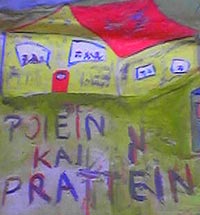
an artist who works with small scaled installations making up the order of things, the image of which is depicted on the page introducing philosophy on the website of Poiein kai Prattein, and this in memory of Michel Foucault's 'les mots et les choses' or 'The Order of Things' for the English translation.

Hatto Fischer
Athens 20.6.2012
Exhibition SYNECDOCHE
29.10.2011 until 21.1.2012
Once gallerist and curators combine to bring art works to the fore, it is interesting to see when the art works selected and put on display seem to still remember the great art works of the past. At least, this feeling I had when visiting the Bourouina Gallery which had an exhibition of collages in November 2011. What had been achieved already in the past must also be a goal for contempory artists, told us Amel Bourouina sitting behind her desk and telling us visitors that she was very pleased with what the curator Johannes Sperling had put together. This exhibition of collages pertains primarily to form. For one or another reason Feiniger keeps coming to my mind.
Insofar here an attempt is made to uphold form in art, what impulses shall enemate from such an exhibition and line adopted by the Bourouina gallery for future artistic work? A simple answer cannot be expected from a short visit to the gallery nor alone from the art works on the display. Yet already the special publications – in the form of newspapers – something can be gathered here aesthetics means as well ongoing reflections from sketches to completed art works. As to the exhibition itself, the concept as explained in the press release was to transform a 'figure of speech' into something in which a part replaces the whole or vice versa the whole the part.

It could mean reality can be perceived in a double way: by giving something a definite form, it is brought into existence (water begins to exist concretely as lake or river) and by reflecting how certain formulations or figures of speech come to mind when we see and experience things, the analogy of things is made evident. Having said this, there is no need to remind that 'parts and whole' played a crucial role in the aesthetics of Matisse. At the same time, the claim of truth in relation to the whole has not only undergone radical changes in the twentieth century, but has been permanently disturbed by what was at least in Eastern European countries definitely not 'prawda'. The theater maker Johannes Schall would shudder if recourse would be taken to the truth as a whole. The alterations started not only in politics, but as well in physics when Heisenberg's relativity principle replaced Einstein's quest for the unity theory. To Heisenberg, it was only possible to detect either the parts or the whole; they were exclusive to one another, and besides the observer in the experiment was as well a disturbance. Thus the whole could not be identified together. It led in philosophy Adorno to counter Hegel's claim the whole is the truth with a statement coming directly from 'Negative Dialectis', namely 'the whole is not the truth'.

Whether or not this was conscious to the artists participating in the exhibition or to the curator cannot be deduced from the materials made available. The opening took place on Oct. 28Th 2011 and the exhibition shall continue until January 21, 2011.

As to the reference to collage as an art form, certain aesthetical configurations come into play with that. They may remind of past achievements while wishing to uphold certain criteria in the present. Thus it is like saying this is art. Not by pointing a finger, but still by making a strong emphatic statement. The question is if this artistic direction shall acquire in importance over time with many other artists adopting such a strong aesthetical principle?

I am inclined to say that one has to be most careful with the collage as form. First of all, the claim that this suits our present time comes close to being a sort of rationalization with the claim of actuality not so easy as it sounds. Secondly, collage can mean the application of the Surrealist principle of juxtaposition: opposites are brought together like a feather and chain saw, but then which parts match and go together that is altogether a matter of the departure point is the fragmentation of what was a whole in the past like a vase which broke after falling onto the floor or if we follow a dective collecting pieces of the puzzle to have a clue about when on that specific night. Thirdly, the Bauhaus did not assemble a diversity of texts, symbols and messages to make up something like a collage, but it was meant to fit an architectural principle of unity. Hence the design was intended so that living and space could go together even though this could fall into the trap called 'dictatorship of architecture'. The latter was reinforced by a totalitarian ideology based on the claim that the whole was greater than its parts and the determination of even a collage would specify what role each part had to play to make it appear to be a functioning whole. Interesting in that sense was what fitted, what not and therefore was suppressed, sidelined, silenced and thrown away as if unnecessary ballast? Fourthly, a collage can represent a scene in which everything is engulfed in a kind of collatoral damage. This is certainly the case when seeming contradictions in daily life are nevertheless affected by the overall war. People could sit in an ice cafe while one street further a car bomb would go off to leave in its wake many pieces and human parts. In Israel this is the case after a suicide bomber had struck and special people come to pick up the human parts to safeguard the spiritual wholeness of the persons who have died. A collage like this could reveal when the overall message of peace is lost in the mess created by times engulfed in war. Fifthly, it is natural to expect that a collage nowadays is much more refined, but the question  if there is still space for a surprise i.e. something unexpected entering the frame and bringing all the previously existing pieces in disarray like when men standing in a room are disturbed once a beautiful woman enters and draws their attention upon her.

Of course, a collage can involve as well that well known element of someone cutting out of magazine an assembly of images depicting cars, dolls, streets, symbols and people on the move. It is also possible to recreate an entirely new image out of the variety of just symbols. And if there is something more to tell, then a piece of wood in the collage would take on another texture if the rest was made of drawings on paper.  The moment different levels interplay, then the entire picture becomes something else. This is how transformation works and which might interest a particular artist. Yet a grumbling in the background can be heard when this is suggested merely as a possibility. For many collages remind too much of a mere mechanical re-arrangement of different parts and still after having moved the furniture around for the x-time, nothing seems to fit. While every worked out collage has its own secret, transformation may just be in play as when Picasso made the handlebar of a bicycle become suddenly the horns of a bull. However, that is not collage as such if it remains as it is a distinctive part set apart from everything else.

Given the claim made by this specific exhibition that the collage is the most suitable form to reflect the present, then one has to note that this is done with a descriptive extension of the collage as a „pool of possibilities“. The danger here is tht these possibilities turn out to be static entities once fixed within a certain arrangement, and which are disposed to argue with form, colour and texture about only certain things while leaving out the rest. That would explain a kind of askese in search for pure forms if that happens.

However, over and beyond all that there exist in all art forms different layers of meanings as to what is possible with the strongest statement still being what is declared as being impossible. Here the collage proves its own limitation. For the individual parts cannot easily give up their insistence of having their own respective and distinctive parts for otherwise they would dilute and flow over into the larger surface surrounding them to become one with something else. Set apart, the parts have to deal with uniqueness at a different level than the image as a whole. Maybe this is also not the intention of the collage and follows Heisenberg insofar as the viewer may see only details but not the whole or else if the whole is viewed the seperate parts disappear like objects in a big fog. The advantage of the latter is that the fog allows the focus on one particular object e.g. the latern.

Yet if this reflective discourse is a faint reminder of something, then the contradiction collages entail. They need certainty to tell their story and cannot deal with uncertainty not as a wavering in opinon but as ensuring the work on the art work continues in order to let the colours breathe (Chagall). If there is by contrast too much certainty due to the particular and peculiar delineations between the various parts without being sure what this means altogether, then any viewer thereof can have the feeling of experiencing something arbitrary. It would suggest that the flight into the collage may be in reality a kind of order sought for feelings of insecurity about form prevail too much and therefore it is impossible to give meaning to existence as perceived by the eyes when walking not merely through the streets of a city, but through life! The jump into the unknown can happen anytime, and this not only as a moment of surprise, but as a basic metaphysical presence. Thus a collage which would hide still the most evident question about existence would favor an order to suppress that unknown. Such an order would not come out of the interplay of the parts, but be imposed finally, even if at first in a seemingly un-structured and not orderly way. It would be of interest where this is possible to tell what is happening in the individual art works on display. Definitely the use of the collage to express 'figures of speech' supposed to reflect the present may entail as an expression something else called fear of arbitrariness.

Hatto Fischer 4.12.2011
« New Art Galleries near Check Point Charlie: Rudi Dutschke and Charlotten Streets | Aurel Scheibler Gallery »