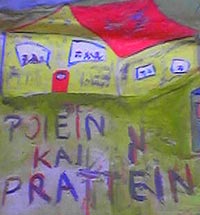
Ποιειν Και Πραττειν - create and do

Ten finger research approach


CIED (Cultural Innovation and Economic Development) stands for a cultural approach to economic affairs and should lead on to ‘Good Practice’ when it comes to trying to achieve ‘sustainable development’.

As such it includes not merely environmental concerns but deals as well with the complex issue of ‘measurements of sustainability’. The latter has to be derived from culture, economy, political and social institutions as well as from the physical environment.

The CIED methodology is based on what can be assumed to be the capacity of individuals but equally of institutions to ‘work with indicators’.  Decisions, planning interventions and expenditures need always to take stock to know reality. That is as important as the balance man needs if to walk in an upright manner.

A humane manner of speaking about praxis has a theoretical dimension. Unfortunately that goes too often unnoticed since culture is never really understood as being also a way and indeed art of perceiving things. Thus CIED maintains that cultural reflections have to included in these measurements.

CIED organized a European conference in Leipzig 1999 to deal with this linkage between quantitative and qualitative measures or how to make possible that the ‘non-measurable becomes measurable’ (Anne Pender / Frank Convery, Dublin). Departing from this background and in taking into consideration the experiences made as an Article 10 – ERDF project, 'working with indicators' means including as well the voices of poets and of the cultural sector when dealing with the refinement possibilities of planning methodologies. By including cultural reflections when it comes to attract inward investments, good practice can defined as part of the prevailing cultural consensus which guides local and regional authorities towards other kinds of interventions and investments once it becomes mandatory to take culture into consideration.

Cultural sustainability has to include the valorization of cultural heritage and natural landscapes in both tangible and intangible terms. For something known in the past and in need of still existing when future generations undertake it to comprehend the different layers of cultural experiences mankind has made over time, is as crucial to attain sustainability as is wise water management.

The World Summit 2002 had undertaken it to fulfill four strategic objectives:

  1. increased global equity and an effective global partnership for sustainable development
  2. better integration of environment and development at the international level
  3. adoption of environment and development targets to revitalize and provide focus to the Rio process; and
  4. more effective action at national level with stronger international monitoring


While the first one is clearly about partnership and relates, therefore, politically to the key term ‘coalition of responsibility’, the second one is both a value premise and goal to be achieved by such global partnership aiming to work out the conditions for fulfilling the objective of sustainable development. Whether or not this can be achieved by ‘better integration of environment and development’ remains to be seen, for skeptics would argue already here not integration, but avoiding and stopping certain developments would only make possible a higher respect and regard for nature while the ‘environment’ ought not to be so much protected, as left alone – something given the world population growth and with it the expanding cities others would argue is an impossible thing to do. Still a poet like Paula Meehan in Ireland would say, there is a difference between untouched nature or wild spaces and where man has to intervene as the discussion about reasons for forest fires indicate.

For further information about the crucial background for this debate and what has become known as Agenda 21 see, for instance, what the European Commission provides on this subject matter:

http://europa.eu.int/comm/environment/agenda21/index.htm

After a brief introduction, CIED's way of perceiving the WSSD was structured in accordance to a ten finger system to facilitate entry into comprehensive and complex issues while providing at the same time an overview when it comes to link the various issues of sustainability as well to such crucial matters as education for sustainability and cultural i.e. literary expressions of sustainability. It seems that the most important criterion in need to be observed is what people can uphold and therefore sustain themselves. The technological capacity has transcended so often that human boundary without heeding that basic wisdom.


  1. International relations mediated through governments, international institutions (United Nations), NGOs: leading world opinions
  2. Urban and Regional Sustainable Development / Quality of Life: Planning for the Future
  3. Energy, Transport, Infrastructures for development: where do they lead to
  4. (Un)- employment and work organization in a global market
  5. Economics and Business: the financial world and corporate morality vis-à-vis sustainability
  6. Civilization, Human Values, Democracy, Human Rights, Governance: What is left of Human Civilizations around the Globe?
  7. Education for sustainability
  8. Literature and Sustainable Development
  9. Health issues: malnutrition, safe food given agricultural developments, but also AIDS, Mal-nutrition, Pollution, Cancer, Heart Diseases
  10. Consensus building in the modern world: forms of partnership, agreements, conventions


^ Top

« Application of CIED: Cultural Cooperation | Introduction »