Navigation
- Home
- Philosophy
- Europe
- International
- Peace efforts
- Poets
- Culture
- Conferences
- Newsletter
- Links
- Imprint
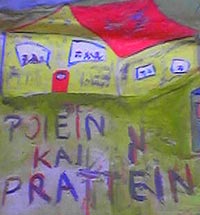
A visit to Andrej Woron
 Boudewijn Payens, Andrej Woron and Jad Salman
Visit on Friday, 18.11.2011
When I was again in Berlin during that November month in 2011, this was because Jad Salman and Boudewijn Payens both wanted to see not merely galleries, but to get to know some of the aesthetical references which have influenced my thinking about the arts.
When we arrived in the Friesenstrasse where Andrej Woron lives, we were warned that the bell does not work. So we had to call him over the mobile phone so that he could open up the door for us.
As we came up the stairs, he was waiting already at the top to greets us with some anxiety written all over his expressive face. He explained to us that over two years now that he is trying to get the house owner to fix the opener for the door, but nothing happens. He looked at us with some expectation to show a reaction, but what to say to someone who makes amazing stage designs with his own hands and yet cannot repair himself that door bell! Maybe it was, however, a way to see how we would take his explanation. Since we did not react, he continued to apologize but our visit has to be brief. First of all, he was suffering under a bad cold and secondly, he had besides that not much time. In half a hour a choreographer was coming.
Later on, when our discussion was interrupted by a phone call, he returned to us to explain while working for two operas, one in Bremerhaven, the other in Halle, this call was already about engagements for 2013 and 2014.
We insisted that we do not wish to disturb him, but if he could briefly take the time to look at the works of Jad Salman, then that would be fine.
Without further explanation he invited us into his apartment. Already in the corridor shelves greeted us. All of them reach right up to the ceiling and are filled with all kinds of books. Later on he would show us a favorite one of his. It is a book about African masks or rather painted faces! It indicated from where he would obtain inspirations for his varied and highly artistic stage design and customes.
His aesthetical reflections of the works by Jad Salman
With all his sensitivity, Andrej Woron is aware how precarious and precious is the existence of man, and this at any given time. Therefore he does not take anything for granted. He is a true artist and dedicated to what is entails the art of making art. Faithfulness translates thereby into a constant struggle to be truthful in what one is doing. This to him taking the time to take a look at the work of Jad Salman. What was said within that short time period can be considered like a lesson for a life time especially for a young and aspiring artist like Jad Salman. Here then some of the aesthetical principles Andrej Woron referred to while looking at the art work of Jad Salman spread out in front of him on the wooden floor and as well to be seen in a sketch book Jad had brought with him.
 Andrej Woron looking Photo by Boudewijn Payens
Ästhetische Prinzipien von Andrej Woron - Anmerkung zu den Arbeiten von Jad Salman

Ich möchte gar nicht Lehrer mehr sein. Das war ich vor einer langen Zeit, aber jetzt nicht mehr.
Es ist schwierig Kritik zu üben. Ich will niemanden verletzten.
Na ja, schauen wir mal diese Bilder an.
Ich sehe der Junge hat Talent aber er muss noch sehr viel arbeiten.
Wenn mein Blick über seine Bilder zu schnell hinweg gehen, also nicht bei einem einzelnen Bild stehen bleiben, dann ist das kein gutes Zeichen.
Der Blick muss vom Bild angehalten werden.
Ach bei den Bildern mit einem grösseren Format sehe ich eine positive Entwicklung. Das ist schon etwas. Der Ausdruck gefällt mir, nur muss er noch viel mehr daran arbeiten: geistig aber auch körperlich.
Er muss Abstand finden und sich mit dem Bild auseinander setzen.
Ich will nicht so viel sagen, aber eines möchte ich schon betonen: die Gefahr des Informellen. Das ist eine ganz schlechte Kunst. Die gefällt mir ganz und gar nicht.
Mir scheint es er gibt sich manchmal allzu schnell zufrieden. Nein, er muss nicht mit solchen Bildern zufrieden geben die man in jeder Ärztepraxis zu sehen bekommt. Stattdessen muß er solange daran und an sich arbeiten, daß er eher noch unsicher wird in was er da vor sich auf der Leinwand hat. Erst wenn er ganz unsicher ist, dann hat er vielleicht etwas gefunden.
All das ist noch viel zu abstrakt. Er muss konkreter werden oder besser gesagt das Abstrakte konkretisieren.
Ja, bei diesen Arbeiten sehe ich ein Talent und er hat da schon ein gutes Gefühl für Farben und räumlicher Einteilung, aber er sollte es auf einem viel größeren Format versuchen und sich nicht allzu schnell zufrieden geben. Heutzutage denken die jungen Künstler zu früh daran wo werden sie ausstellen statt darauf zu achten was sie ausstellen werden.
Ich habe das Gefühl die jungen Künstler müssten sich vielmehr die Zeit geben ehe sie ihre Bilder in einer Ausstellung zeigen. Sie setzen sich damit einer Gefahr aus allzu schnell vom eigenen Weg abzukommen. Sie müssen sich erst finden so dass das Bild die eigene Handschrift trägt, und jeder Betrachter sagen kann dieses Bild wurde von diesem und keinem anderen Künstler gemalt.
Aesthetical principles of Andrej Woron - remarks to the works by Jad Salman

I do not want to be any longer the teacher. That I have been a long time ago, but now no more.
It is hard to exercise criticism. I do not wish to hurt anyone.
Okay, let us take a look at the pictures.
I see that the boy has talents but he must work still very hard.
If my glance passes over a picture too quickly, and does not come to rest on just one picture, that is bad.
The glance must be held steadfast by the picture.
But in the pictures of a larger size, there I see a positive development. There is something. I like the expression, only he has to work on them much harder, not only mentally but with his body.
He has to find some distance to his work and confront himself through them.
I do not wish to say too much, but one thing I want to emphasize: the danger of remaining informal. That then would be bad art. That I do not like the least bit.
It appears to me at times he is too quickly satisfied with what he has produced and then rushes on to the next. He should not be satisfied all too easily as it would mean producing only those pictures you can find in any waiting room of some doctor or dentist.
Instead he should and has to work for a long time on them, so that he becomes ever more uncertain in what he has there on the canvas in front of him. Only when he is completely uncertain, perhaps then he might have found something.
Everything is still all too abstracxt. He must become more concrete or rather he has to concretize the abstract.
Yes, in these works I see a talent and he has already a very good feeling for colours and for spatial divisions, but he should try out himself on a larger canvas and not to be too readily satisfied with what he has achieved. Nowadays young artists think much too early as to where they will have an exhibition than about the real substance of their works.
I have the feeling that young artists should devote much more time to their work rather than be occupied to show their pictures in an exhibition. They expose themselves as a result to the danger of deviating from their own path. They have to find first what carries their own handwriting so that everyone can recognize that painting stems from that artist and none other.

Jad Salman listening to Andrej Woron Photo by Boudewijn Payens
There is still another side to Andrej Woron: not the painter but the stage designer, theater director and who knows what else when bringing pictures of his rich imagination onto the stage. It is like paintings coming to life when actors begin to act out scenes within a setting he imagined would fit that specific interpretation of the play.
That side of him I don't know really well as his success with Theatre Kreatur began after I had left Berlin to live in Athens. Only recently we met again and then by coincidence at an exhibition shown at the Academy of Arts. The exhibition was about two cities having problems with water: Venice with too much water, Las Vegas nearly without! He greeted me with great happiness to see me again. The feeling was likewise.
About his work as stage designer and theatre director, more needs to be said later. When we were visiting him, he was preparing two sets for operas, one in Bremerhaven and the other in Halle. One of them had to be ready by January, the other three months later in April 2012.
As to his work place in the flat, there is this special room filled with tools but also models of his most recent works.

Work place of A.W. Photo by Boudewijn Payens
By taking a closer look at his models for another set, it was easy to gather evidence of his incredible work. He is clearly capable of transforming even the most trivial stage into a magical place. And as one critic of his work points out, he wishes to be phenomenal or to express astonishment when finally everything fits together: actors, set, music and the text interpreted in a novel way. The only word in Polish to say it is 'kurwa'. That expresses best his entire personality for he is a true artist.

It is, therefore, all the more interesting what he undertakes in order to substantiate the language of the theatre, customes and sets included, with what is his understanding of painting.
When we were about to leave and apologized once again for taking his precious time, he said something that can only be understood how he meant it when understanding him as the artist that he is and has become through this recent work on stage. He said with sadness in his eyes and touched by this encounter with the work of Jad Salman: "you know I have betrayed my own painting!" He meant that he has given up to paint 15 years ago and how he knew him when we had worked together.
On the way back to the U-bahnstation, but already at the corner of the Friesenstraße on which he lives, we noticed a bookshop. Oddily enough it had at the top of its window a gun in neon light as if wishing to advertise inside are waiting 'Krimis': books dealing with crime or crooked stories! Yet it was not necessarily about the myth about smoking guns. The latter play usually a role when foreign powers suspect someone like Saddam Hussein in Iraq 2003 that he had used them when in fact there were none. The spotting of the gun was an unexpected reminder with what attrapes we are surrounded with when in fact a real world had just been revealed to us by visiting Andrej Woron. It underlines once more the need for such honest artists who really create and give freely their best whenever asked.

Bookshop in Friesenstraße, Berlin Photo by Boudewijn Payens
« Andrej Woron | Roger David Servais »