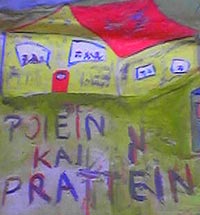
Ποιειν Και Πραττειν - create and do

Literature


Literary cafes in three cities


Cafe in Paris                                     @Hartmut Schulz

Always writers meet in specific places; for Sartre and Camus it was a certain cafe in Paris but all over the world people mingle in such places. They seem to be most receptive to new ideas and besides a cup of coffee will make the day more bearable.

Rosalinde in Berlin no longer exists on Knesebeck but used to be a meeting place

the Cafe was located on Knesebeckstr. between Goethe and Savigny Platz in Charlottenburg


Angelika Sollich (optician), Roger Servais (painter) and Hatto Fischer


Spyros Bokos                                Philosopher of Religion

In Berlin the cafe Rosalinde was such a place. Adopted by writers who did their readings under the auspices of the late K.B. Herbach just around the corner, they started to come there every Thursday after the reading to drink a glass of wine and to discuss. You can find still traces of that today in Rosalinde. Books are kept in glasses otherwise used to preserve marmelades. (At Phileion in Athens one can find likewise books that some of the writers have donated for visitors to that cafe just in case they find the time to take a glimpse in the book while waiting for someone to come.)

Most memorable has been the meeting with Ernst Schnabbel in the Rosalinde in Berlin. This author of the book 'I and the kings' (about Daedalus and King Minos) understood like no one else how to set free such literary expressions which let people dream. Ernst Schnabbel did this especially with his radio program 'in eighteen days around the world', a program he produced immediately after 1945 and before people could really travel as they do nowadays.

To set dreams free was an important expression of Ernst Bloch, and like the imaginary museum of Andre Malraux, the cafe is where you would want to meet just as much Thomas Mann, Heinrich Boell, Robert Musil, Thomas Bernhard, Pindar, Carlos Fuentos, Elias Canetti, Josef Konrad, Uwe Johnson as the muse who sets free the imagination of the writer by just walking past the table.

2007 is a time measure. World literature has seen some astonishing twists and turns with more poets receiving the Nobel Prize than perhaps writers or is that only an impression? Certainly Pablo Neruda and Seamus Heaney link up in a row of distinguished poets while those writing novels, books as they are called, find themselves like Guenter Grass exposed to a controversy which began in the days of their youth and never could be silenced. That then applies as well to Peter Handke.

There are others like Orhan Pamuk or Naipaul who know of those other cultural values in need to be preserved if not by institutions then by writing about them until these messages are translated into other languages.

This is no reference to literary cafes or such cafes set up for writers to do readings, but rather they are the ones which have been adopted due to most unknown circumstances by writers, poets and artists as their meeting place. These places do not give us as of yet a feeling of dexterity but then a word of caution comes from an American writer like George Crane who would declare through his writings that soul and thought must go together, if it is to be a good piece of literature.

Cafe in Kolonaki, Athens

- a brief reminder of a specific locality called Phileon on Skoufa


Philion Café at corner Skoufa / Lycabettus in Kolonaki, Athens 19.1.2007

There you were sitting, reading, waiting, thinking

Insofar as I came but did not arrive

As I was gone already before I came

And so I programmed my terrible loss

Only felt when you, my love, no longer

Are sitting there but I, hungry for news,

I no longer read newspapers but my heart beats away,

Always listens to your heart

Now so far away but still I listen for faint sounds

Reminding me of your presence once sitting there.

or 'Nice & Easy'at the corner Skoufa and Omirou, tucked away behind Rosebuds by the stairs going up to Lycabettou hill

Nice & Easy has as wall paper photos of movie stars like Marlyn Monroe. It is a hush of silence which has spread over the sixties and seventies. Since then heroes of films have become politicians like Ronald Reagan while still it is a challenge for a writer of a novel to see his book be transformed into a film. Umberto Eco was satisfied on how 'In the name of the Rose' turned out. Literature told on the screen is as different as an actor on stage in front of a camera, would say Norman Cohen who loved 'Nice & Easy', but also around the corner another place he favors for the music, mainly jazz, they play. That place is called 'Low Profile' and is just around the corner from 'Nice & Easy'.


Over there - in Brussels

LaVache

If one is not careful, then in LaVache successive 'no's' by a woman to a man can be heard (and everyone laughs about his efforts since in vain to stay connected over time)


La Vache cafe near Place Louisa in Brussels

As the literary saying goes:

No one wishes to hurt anybody’s feelings, says the writer, but then, look over the brim of your glasses, and you see spectacles that make seeing but not believing, hearing but not understanding into a kind of miracle or merry-go round not for children, but adults with the capacity to say ‘no’ to love growing by the hour since stakes are raised with each denial of a small possibility that this might be the wrong choice of words, the lack of curiosity for wishing to know the reason why abating like the wind in the bay to give the heart, soul and mind some respite from the changes occurring since the previous night out of an unexplainable longing for some basic truths as if answers can be given by reading in the tea cup the future for no one to see but to anticipate like us growing older by not the years or months or days but by seconds of missed opportunities to halt this negativity roaming loose out of fear to commit anything in the name of love to some ritual of behavior understood as being faithful not out of an idea born in the arms of the other but by being true to life despite all its turns and delays, whispers and shadows of the past.

And the fourth one,
the ARCADI Cafe in Brussels

That cafe opposite the once main building of Brussels 2000 can be considered a true meeting place between friends, especially when someone like Bart Verschaffel drops by. This philosopher, once coordinator of literature when Antwerp was Cultural Capital City, is now Head of the Faculty for Architecture and Planning at the University of Gent.

Here then something written down in small Moleskine note book while sipping tea and tasting a good lemon pie at that cafe; it goes something like this (and after having read George Crane's book: 'Bones of the Master'):

Chinese wisdom says: Cup your hands, make warmth into a sound, for it elongates dreams, life is like that, only holy if true and good if loved like rain washes of dust, goes away the pain at dusk, when winter sheds coat and sunshine adds to human warmth all over the world.

HF After Paris Berlin, Athens and Brussels 4.3.2007

^ Top

« Franziska von Woyski | George Crane, author of “Bones of the Master” »